Posts

Ministers support outstanding architecture shock

The draft National Planning Policy Framework has been well received by those who want to get things built, and criticised by those who don't want things to be built. This suggests the Government has got it about right. But what about those who would like to see things getting built - but only things that are any good?  Everyone has anecdotes of how well designed schemes get bogged down in the planning system while mediocrities are waved through - it is a commonplace of what passes for 'planning' in England. The NPPF, perhaps surprisingly, offers some hope.  At clause 121, it states that '...significant weight should be given to truly outstanding or innovative designs which help raise the standard of design...'.  This is, in effect, a version of the PPS7 'country house clause' (or 'Gummer clause' after the Environment Secretary who brought it in), but applied to all development everywhere.  The wording doesn't go as far as providing a free pass...
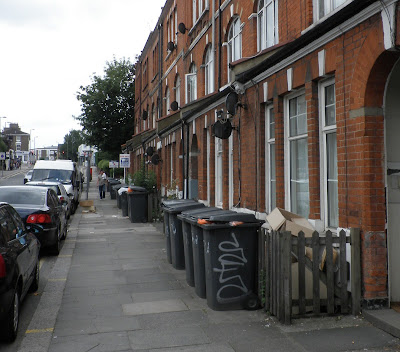
A load of rubbish - paladins and Palladio

Image
It's unsightly to have a collection of rubbish bins right next to your front door - and unpleasant, and smelly -  but many homes in London have to put up with this.  Here is a terrace of houses on a main road in north-west London - Finchley Road in the London Borough of Barnet - where outside every door there are several bins - on a permanent basis, as far as I could tell. 'Dignity never been photographed', according to Bob Dylan - it certainly hasn't been here. This is no way to live, and I bet refuse was dealt with in a more dignified way fifty years ago. Getting rid of waste and sewage is one of the basics of civilised city life - it is common to hail Bazalgette as a greater hero of Victorian building than any mere architect - but here is an area where progress has gone into reverse.  Across much of Hackney, massive plastic bins sit outside the fronts of houses right next to already obtrusive but now redundant purpose-built bin enclosures that are not high enough....

TheTsunami Memorial

Image
A short walk from Zumthor's 2011 Serpentine Pavilion is the new Tsunami Memorial, to be found in the grounds of the Natural History Museum and designed by Carmody Groarke. Carmody Groarke are architects, but this is a a highly successful work of abstract sculpture - they were clearly not tempted by Adolf Loos's observation that memorials and tombstones offer the only opportunities for true, pure architecture untainted by the mundane requirements of a functional brief - though they probably still had a job persuading the QS and project manager of the necessity of transporting a single piece of granite weighing more than 100 tonnes to the site.  The memorial strikes just the right notes of dignity and seriousness of purpose, its weight and permanence a poignant contrast with the fragility of many of the coastal settlements that were swept away by the wave. The only criticism I would make is that the only way to get to it is by pushing one's way through the dinosaur-fancying ...

Summer at the Serpentine - Zumthor goes creosote

Image
To this year's Serpentine Pavilion, Hortus Conclusus , which was designed by the Swiss architect Peter Zumthor, a man that many would put on their 'greatest living architect' shortlist. Hortus Conclusus - 'enclosed garden' - didn't do it for me (though if you are interested in architecture you should go and see it).  As an idea, a garden within a garden in central London is a bit odd, since arguably people not already in a nice park, for example in large areas of Tower Hamlets where there aren't any, might benefit rather more from the planted space offered by the project - which was a nice enough bit of planting, but hardly memorable.  But even if you accept the idea of an inner sanctum space for quiet contemplation away from the frisbee throwing throng in the park, unfortunately, everyone and their dog had gone there at the same time as us, and opportunities for contemplation were limited. As a building, this seemed to me one of the less interesting or ins...

Temporary insanity

Image
A stroll along Chelsea Embankment this week brought on a double take as Wren's Royal Hospital appeared to have been moved 100m towards the river and undergone a moronic and visually distressing PoMo makeover.  No long term harm done, except probably to the grass not yet recovered from the Flower Show, since this turns out to be a temporary tented city housing 'Masterpiece', an event billed as the 'best of the best from around the world' - best of what, I couldn't work out, but the punters were being greeted by cab-door-opening flunkeys in top hats, moonlighting, I suspect, from door duties at a 'gentleman's club' (of the E1 rather than SW1 variety).  Things are generally all of a piece, and the general mismatch between aspiration and what you could see was at least consistent. Aside from the question of the marketing wisdom of claiming that you could find the best of anything inside here, this bizarre sight prompted a couple of other thoughts. The fi...

Pro-growth

Image
The AJ's Forgotten Spaces competition shows how neglected spaces can be revived thought the application of creativity and ingenuity, but those qualities are not alway in plentiful supply, and there are plenty of places that could be improved just with grass and trees and flower beds. Run down public housing estates are an example. 'Estate regeneration', in London at least, seems to start with consideration of the building stock, but often it is everything between the buildings that is really the problem.  Some publicly or RSL-owned post-war housing estates have appallingly neglected 'public' realm where every (generally undesigned) intervention that does take place, from the location of bins to the erection of barriers, seems to say to tenants 'you don't matter and we don't care'. But it's not easy for the landlords, even if well-intentioned - compared with more traditional layouts, such estates are full of too may acres of 'space left over ...

Infrastructure before Expansion

Environment Secretary Caroline Spelman, interviewed this morning on the Today programme about water shortages, used a phrase new to me: 'I before E', meaning Infrastructure before Expansion. A bit of googling reveals that this neat coinage dates from at least 2003, but it is surprising to hear it used approvingly by a cabinet minister, since it seems to imply more planning than is happening now, and not at a local level ('regions' and 'regional' are words banned in Government now, so the hunt must be on for a new term - how about 'arch-counties', which has a nice Anglo-Saxon, Little-England-friendly ring to it?). In fact, the Tories have over the years been better than Labour at getting on with big infrastructure projects, at least as far as transport is concerned.  They need to rediscover that bit of their heritage, particularly as the debate over High Speed 2 reveals all the predictable political tensions, made more problematic by the tenets of localis...